Saint Weddings · Destinations · Greece
A wedding photographer for Greece
Greek light is the hardest light we work in and the most generous once you respect it. Whitewash reflects like a studio bounce, the Aegean throws a second sun back up at you, and the middle of the day is unusable in a way no Italian coast prepares you for. Photographed on its own terms, nowhere pays back better. These are our field notes on the country.
Two Greeces, and they photograph differently
The islands are vertical, public and theatrical. Whitewashed volumes, cliff terraces, a sunset that the whole island turns to watch at the same minute. Capacity is small, logistics are a puzzle, and the reward is a frame nobody mistakes for anywhere else. Santorini is the extreme case and has its own field guide.
The mainland Peloponnese is the opposite and it is where most of the country's genuinely private luxury weddings now happen. Olive terraces, hilltop estates, water that is calm because it sits inside the Argolic gulf rather than facing the open Aegean. It is reachable by road from Athens in roughly two and a half hours, which changes everything about guest logistics, supplier access and what a production can physically bring in.
If your guest list is over eighty, or if you want the day to feel unobserved, the mainland is almost always the right answer and the islands are the honeymoon.
Houses and places we plan for
- Amanzoe, Porto Heli, a hilltop Aman of pavilions and colonnades above the Argolic gulf, with an amphitheatre, a pool restaurant and a beach club below. Its field guide page has the detail.
- Spetses and Hydra, twenty and forty minutes by boat from Porto Heli, car free, and the best day after sessions in the country.
- Canaves Oia, Santorini, caldera terraces at the quiet end of Oia, with its own field guide page.
- Mykonos, for couples who want the party to be the point, with private villa estates on the south coast and a wind that decides the schedule.
- Corfu and the Ionian, greener, softer, Venetian rather than Cycladic, and a gentler light that suits couples who find the Aegean too hard edged.
- Athens, for a civil ceremony at the start of the week and a Riviera dinner at Vouliagmeni, before anyone boards a boat.
The legal file, and the wind
Foreign couples marry in Greece on a civil licence issued by the local municipality. Each party needs a birth certificate and a certificate of no impediment, apostilled, and translated into Greek. Most documents must have been issued within three months of the wedding date, which is the rule couples most often trip over. Your planner or lawyer submits the file locally, and you should expect to stay one working day after the ceremony to sign the marriage certificate at the town hall. Start collecting three to six months out.
Then there is the meltemi. From roughly mid July to early September a dry northerly wind runs down the Aegean, and on the Cyclades it can hold at force six or seven for days at a time. It does not usually cancel a wedding. It does flatten veils, ground drones, close the outer decks of ferries and turn a cliff terrace into a wind tunnel at exactly cocktail hour. Mainland gulfs and the Ionian are largely spared. Planning for the meltemi is the single most useful thing an experienced photographer does on a Greek island, and pretending it will not arrive is the most common mistake.
What the work costs and what the venues are actually like are set out in our shortlist of the best wedding venues in Greece and, for the island, our Santorini photography cost guide. Couples comparing this sea with the one we know best usually read our Italy field notes in the same sitting.
Coverage and pricing live with the editions. For everything else there is the questions page, and the commission sheet is one page away.
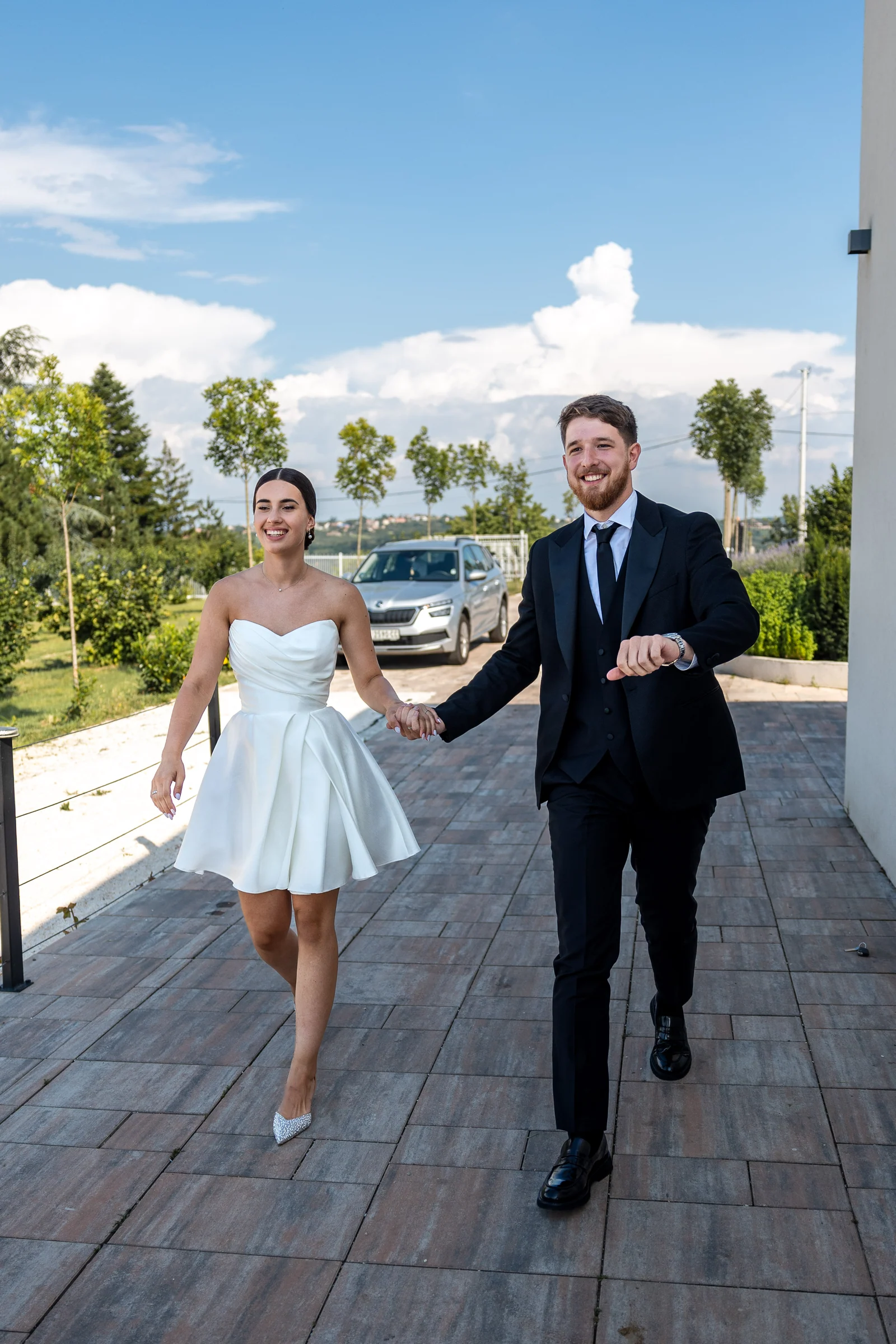
The middle of the day
belongs to the sea.
Planning notes
Working in Greece
When to marry here
Late May, June, and the second half of September into early October. July and August bring heat, crowds and the meltemi together. Winter on the mainland is a secret worth keeping.
The hard hour
Between eleven and four the Aegean light is close to unusable for portraits. Build the day around the first and last two hours and give the middle to the guests, the sea and the shade.
Choose by guest list
Under fifty, the islands work. Over eighty, the Peloponnese works better and is more private. That single number should decide the region before anything else does.
Asked about Greece
Three honest answers
Do you photograph weddings in Greece?
Yes, by commission, on the islands and on the mainland. We scout in your ceremony light the day before, agree positions with your planner and the venue, and quote travel and stays inside one transparent number.
What paperwork do we need to marry in Greece?
A birth certificate and a certificate of no impediment for each party, apostilled and translated into Greek, with most documents issued within three months of the date. The file goes to the local municipality, and you stay one working day afterwards to sign the certificate at the town hall.
Should we marry on an island or on the mainland?
Guest numbers decide it. Small and cinematic favours the Cyclades. Large, private and logistically calm favours the Peloponnese, which is two and a half hours by road from Athens and therefore far easier for suppliers, production and guests alike.
Marrying in Greece? Let us plan the light.
Check your date